

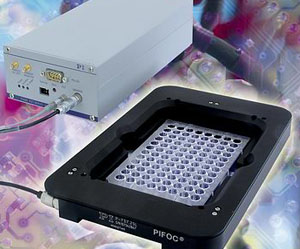
Image Faster
Objective Focusing Stages for Imaging & Microscopy
PIFOC objective focusing stages are designed for automation. They provide fast, precise Z motion for microscopy, genome sequencing, metrology, laser processing, autofocus, Z-stacking, confocal imaging, and live-cell imaging applications.
See products and solutions.
PIFOC High-Speed Nano-Focus Motors: Key Benefits
- PIFOC nano-focus motors provide ultra-fast and precise Z steps with patented piezo ceramic drives.
- Ideal for super-resolution microscopy and high-performance microscope automation.
- Typically faster and more accurate than stepper objective stages.
- 7 msec step time for a typical high-NA immersion objective.
- Systems include piezo mechanics, controllers, and microscope objective adapters.
- Compatible with major image acquisition software packages.
- Capacitive position feedback supports high accuracy and repeatability.
- Moving the objective does not disturb the sample.
- Voice-coil motor driven objective focus control is available for longer vertical travel.
What Is a Fast Focusing Stage and How Does It Work?
A fast objective focusing device is a piezo-driven or voice-coil-driven positioning stage for microscope lenses, enabling rapid, nanometer-precise focus adjustment. It mounts the microscope objective and moves it along the optical Z axis using a flexure-guided or cross-roller-guided mechanism actuated by a piezo stack or voice coil motor.
In a piezo-driven system, the piezo element expands proportionally to the applied voltage, enabling fast, smooth motion without backlash. Integrated position sensors, such as strain gauge or capacitive sensors, provide closed-loop feedback for high accuracy and repeatability.
PIFOC objective positioners are well suited for autofocus, Z-stacking, confocal imaging, super-resolution microscopy, DNA sequencing, and live-cell microscopy where fast and precise axial positioning is required.
Voice Coil vs. Piezo-Driven Focus Stages
Piezo Objective Positioners
Piezo objective positioners are compact, fast, and highly precise. They are ideal when the required travel is short and the microscope objective must be moved with nanometer resolution and excellent dynamic response.
- Compact turret-mounted objective positioning
- Very fast response
- Nanometer and sub-nanometer motion capability
- Excellent for Z-stacking and fast focus control
Voice-Coil Fast Focus Stages
A voice coil actuator is an electromagnetic drive based on the Lorentz force. A current-carrying coil is positioned within a permanent magnetic field. When current flows through the coil, proportional force is generated, producing smooth, continuous linear motion without cogging, backlash, or mechanical contact.
- Millimeter-scale travel range
- High speed and acceleration over the full range
- Smooth direct-drive force generation
- Well suited for larger Z focusing ranges
More Travel, Larger Mechanics
Unlike piezo actuators, which rely on limited material expansion, voice coils are not constrained by piezo strain. This allows voice-coil fast focus stages, such as the V-308, to provide millimeter-scale travel while maintaining high speed and acceleration over the full range.
The longer travel and higher force capability require a larger magnetic circuit, including permanent magnets, a coil assembly, and a mechanical guidance system. As a result, voice-coil stages are typically less compact than piezo objective positioners.
Mounting Considerations and Summary
Because of their larger size and mechanical structure, voice-coil fast focus stages generally do not mount directly on the microscope turret. Instead, they are typically integrated externally or below the sample, making them well suited for applications requiring a larger Z focusing range.
Piezo objective positioners are best suited for compact, nanometer-precision focusing over short travel ranges. Voice-coil fast focus stages provide longer travel and high dynamic performance, but require more installation space and are not usually turret-mounted.